Religion or Science?
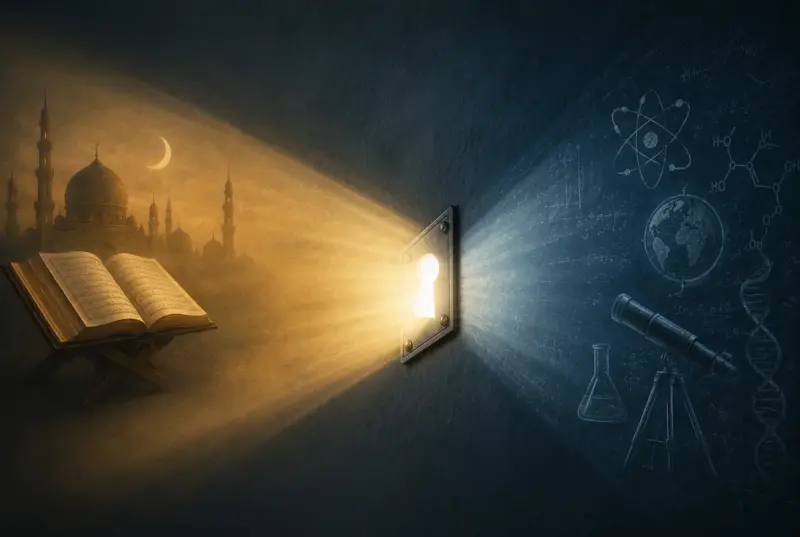
Bediuzzaman Said Nursi held a thoughtful and balanced view of the relationship between religious and modern sciences. He regarded both as indispensable elements in the complete development of the human being. Bediuzzaman emphasized that religious knowledge illumines the conscience and provides spiritual direction, while modern science nourishes the intellect and enriches our understanding of the natural world. In his view, the union of these two forms of knowledge leads to a deeper comprehension of truth.
Bediuzzaman stated that when religious and modern sciences complement one another, they establish the foundation for a balanced and complete form of knowledge. This balance helps people develop both their spiritual and intellectual faculties, enabling them to attain truth and wisdom more fully.
Yet he also warned of the dangers that arise when these fields of knowledge are separated from one another. Without the moral and spiritual guidance of religion, modern science can lead to a sense of emptiness, moral corruption, and doubt. Without scientific insight, however, religious knowledge may harden into superstition and irrational belief.
According to Bediuzzaman, harmony between religious and modern sciences is essential not only for individual growth, but also for the well-being of society as a whole. He believed that this balance helps people realize their full potential, both intellectually and spiritually. By embracing both forms of knowledge, we can understand the world at a deeper level and enrich our lives with both wisdom and truth.
His famous words summarize this insight:
The light of the conscience is religious knowledge. The light of the intellect is modern science. Through the union of these two, the truth is revealed. The student’s abilities develop further through these two sciences. When they are separated, the former leads to superstition and the latter to misguidance and doubt.
With this statement, Bediuzzaman emphasizes that when science and religion are separated, the absence of science may lead to superstition, while the absence of religion inevitably leads to moral emptiness, misguidance, and doubt.