De Risale-i Nur: Een beschouwing door Prof. Dr. Mehmet Görmez
Bediuzzaman Said Nursi en de Risale-i Nur
Een beschouwing door Prof. Dr. Mehmet Görmez
Bediuzzaman Said Nursi, one of the foremost scholars and thinkers of the Islamic world, dedicated his life to explaining the truths of faith to the people of his age. In the early twentieth century, he nurtured a great ambition: to produce a comprehensive Qur’anic commentary consisting of sixty to seventy volumes. As an introduction to this project, he wrote Muhakemat. During the First World War, while serving on the eastern front, he began writing Isharat al-I‘jaz (Signs of the Miraculousness of the Qur’an), intending it to be the first volume of this monumental commentary.
However, between 1915 and 1918, shortly before the Bolshevik Revolution, he spent a considerable period as a prisoner of war in Russia. During this time, he personally witnessed the profound impact that ideologies such as positivism, materialism, and communism were having on the spiritual lives of both Muslims and Christians. As a result, he set aside his original project and devoted himself instead to addressing the crisis of faith facing the modern world.
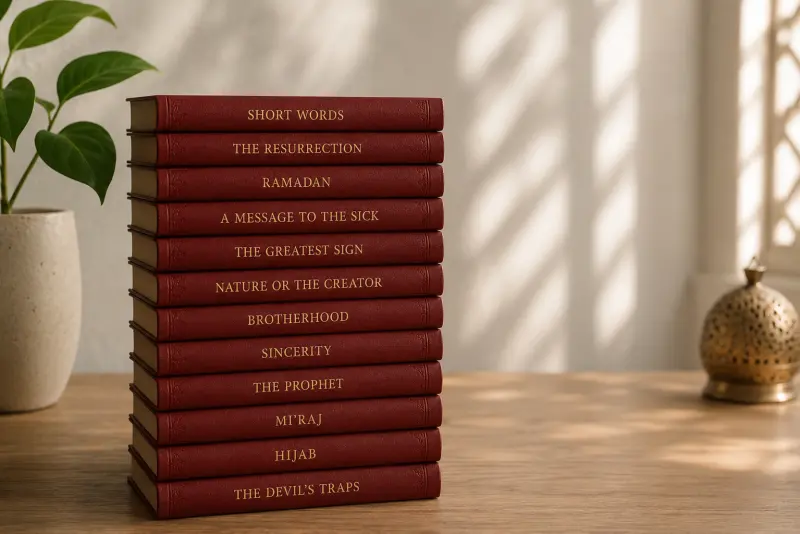
In his writings, he explores a wide range of subjects, including the fundamentals of faith, Islamic ethics, the wisdom behind acts of worship, the unity of the Muslim community, creation and the Hereafter, the purpose of human existence, the wisdom underlying creation, and the manifestations of Allah’s Names throughout the universe. He also examines the relationship between the human being as a microcosm and the universe as a macrocosm, while addressing themes such as sincerity, brotherhood, frugality, contentment, gratitude, youth, illness, and old age. Above all, he sought to present the teachings of the Qur’an in a clear, persuasive, and accessible manner suited to the understanding of modern people.
Yet the works he produced were met with continual persecution. Both he and his students faced repeated exile, court proceedings, and imprisonment. Until the military coup of May 27, 1960, his writings were brought before the courts dozens of times. Even into the late 1980s, they continued to be subjected to legal scrutiny in hundreds of separate cases, every one of which ended in acquittal.
Throughout these proceedings, the courts repeatedly sought expert opinions from the Turkish Presidency of Religious Affairs (Diyanet) and the Supreme Council of Religious Affairs. On every occasion, the Council affirmed that the Risale-i Nur dealt with the truths of faith in the manner of a Qur’anic commentary and contained no harmful or objectionable teachings. Nevertheless, negative attitudes toward Bediuzzaman and his works persisted for many years. Despite all the pressures and hardships he endured, he regarded the writing and dissemination of his works as a sacred responsibility.
In 1947, Ahmed Hamdi Akseki, then President of the Presidency of Religious Affairs, repeatedly requested copies of parts of the Risale-i Nur. Having known Bediuzzaman since their days at Dar al-Hikmat al-Islamiyya, he considered him a friend and held him in high esteem among the scholars of the time. However, because the collection existed only in handwritten manuscripts—many of which still required correction—and because Bediuzzaman was imprisoned in Afyon between 1948 and 1950, Akseki was unable to submit part of the collection to the Religious Affairs Council until 1950. Even then, he managed to provide only two volumes. Although he wished to publish some of these works, he was unable to realize that goal during his lifetime.
Following the military coup of 1960, legal proceedings against Bediuzzaman and his writings intensified even further. During this entire period, the courts continued to seek the advice of the Presidency of Religious Affairs and the Religious Affairs Council regarding the Risale-i Nur. The Council consistently issued favorable opinions. One notable example is its statement of May 13, 1955:
“Upon examination of the works in question, it has been determined that they contain supplications, explanations of Qur’anic verses and Prophetic traditions, expositions of the religious truths found in the noble verses, discussions of the wisdom and purposes of worship, the virtues of fasting during RamadanThe ninth month of the Islamic lunar calendar, during which Muslims fast from dawn until sunset and in which the Qur’an was first revealed., and scholarly, philosophical, and persuasive responses to questions concerning Islam. In his sermon known as ‘The Damascus Sermon,’ delivered in the Umayyad Mosque in 1326 AH, he addressed subjects such as unity, courage, heroism, service to religion, and the material and spiritual benefits of the strength derived from faith. Since no statements harmful to religion or the administration of the state have been found, it has been decided to refer this matter to the High Council for consideration.”
The Presidency of Religious Affairs experienced one of the most difficult periods in its history between 1960 and 1966, during which six different presidents held office. During these years, pressure was exerted on the Religious Affairs Council to issue negative reports concerning the works of Bediuzzaman Said Nursi. Nevertheless, such requests were rejected on both religious and ethical grounds, and no negative report was ever issued.
As a consequence, although the Presidency of Religious Affairs published the works of many scholars and thinkers from Turkey and abroad, it did not publish any work by Bediuzzaman Said Nursi until relatively recently. On January 20, 2014, it published Isharat al-I‘jaz for the first time, including both the original text and its translation. The publication was welcomed with great enthusiasm by all segments of society.
When reading Bediuzzaman’s works—as with all books other than the Qur’an—it is important to bear in mind the following warning:
“Brothers! You regard me as your teacher. But you should know that your teacher is not free from error. To consider him infallible is a mistake. Finding a rotten apple in an orchard does not diminish the value of the orchard. Finding a worn coin in a treasure does not render the treasure worthless.”
Bediuzzaman placed greater importance on his writings than on his own person, whom he regarded as weak, transient, and fallible. He said:
“An enduring truth cannot be built upon transient individuals. To do so is an injustice to the truth itself. A mission that possesses perfection and permanence should not be tied to those who are subject to decay and destruction. If it is, great harm will come to that mission.”
He often compared this attitude to that of great scholars such as Imam al-Shafi‘i and Imam Abu Hanifa regarding their own views and opinions. He advised:
“Do not accept anything without first measuring it against the proper standard. Even my words should not be accepted merely because I have spoken them. Do not allow every statement to enter your heart unquestioningly. Let my words remain before your mind and weigh them carefully on the scale. If they prove to be gold, preserve them in your heart. If they prove to be copper, reject them and return them with criticism.”
The standard to which Bediuzzaman refers is, without doubt, none other than the Word of Allah and the SunnahThe sayings, actions, and approvals of Prophet Muhammad (peace and blessings be upon him) that serve as a model for Muslims. of His Messenger (saw)Sallallāhu alayhi wa sallam (Peace and blessings be upon him).
Making the works of Bediuzzaman Said Nursi available to readers—works that are widely regarded as precious examples of our intellectual and cultural heritage—will make a significant contribution to our scholarly, intellectual, and cultural life. We therefore extend our sincere gratitude to all those who contributed to the preparation and publication of these valuable works.
Prof. Dr. Mehmet Görmez
President of the Turkish Presidency of Religious Affairs